
A Heavy-Payload Industrial Cargo UAV can help businesses transport equipment, construction materials, emergency supplies, and other heavy goods to locations where conventional delivery methods are difficult or inefficient. However, selecting the right aircraft requires more than comparing maximum payload figures. Buyers must evaluate effective carrying capacity, flight endurance, operational range, flight stability, cargo attachment, safety systems, and maintenance requirements. This guide explains the essential considerations for choosing an industrial cargo UAV that matches real-world transportation needs and supports dependable operations.
For logistics operators, infrastructure contractors, and industrial project managers, understanding these factors can help reduce delivery delays, improve material handling, and make aerial transportation a more practical part of an overall supply chain.
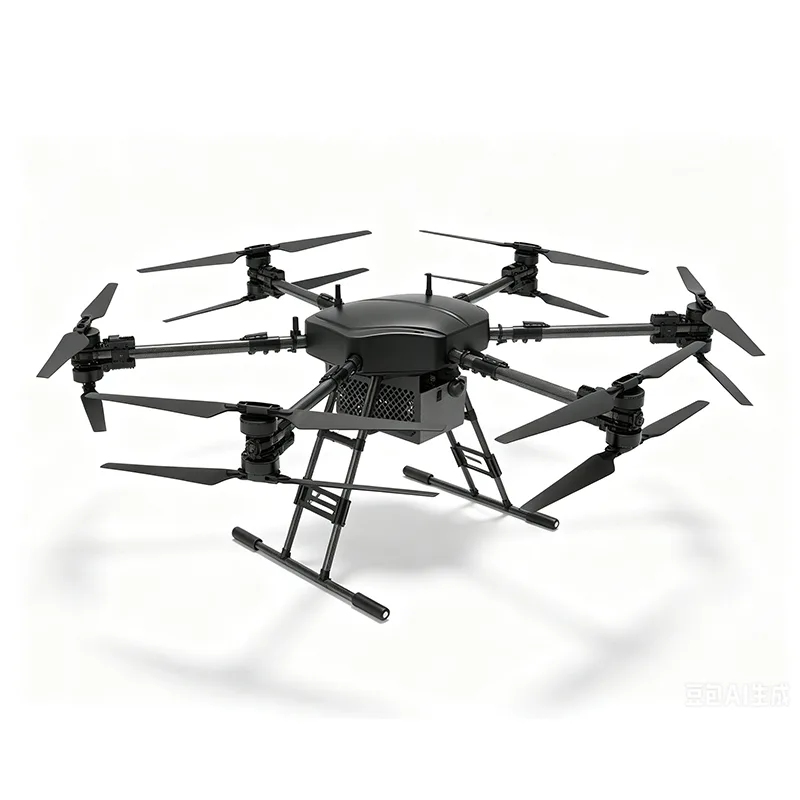
What Is a Heavy-Payload Industrial Cargo UAV?
A Heavy-Payload Industrial Cargo UAV is an unmanned aerial vehicle engineered to transport cargo, equipment, or other operational materials. Unlike lightweight drones primarily designed for photography or aerial inspection, these platforms focus on lifting performance, structural strength, controlled cargo movement, and repeatable transportation tasks.
Depending on the aircraft architecture and mission requirements, a cargo UAV may use a multirotor design, a fixed-wing configuration, or a hybrid vertical takeoff and landing system. Each design offers different advantages in terms of takeoff space, hovering capability, endurance, and route flexibility.
Industrial cargo UAVs generally integrate several systems into one transportation platform:
- Airframe and propulsion: Structural components, motors, propellers, and power systems designed for the intended operating loads.
- Flight control and navigation: Systems that help maintain the planned flight path, altitude, and aircraft attitude.
- Cargo interface: Mounting frames, containers, suspension equipment, or other compatible loading arrangements.
- Communication and monitoring: Equipment that enables operators to monitor aircraft status and manage authorized missions.
- Ground support: Batteries, charging equipment, control stations, maintenance tools, and operational documentation.
The defining characteristic is not simply the amount of weight an aircraft can lift. It is the ability to transport a specified load safely and consistently under a defined set of operating conditions.
Why Are Industries Adopting Heavy-Payload Cargo UAVs?
Traditional transportation methods remain essential for moving bulk materials and heavy equipment. However, ground vehicles can face limitations in mountainous terrain, remote construction sites, isolated infrastructure, and areas affected by flooding or road damage.
A properly selected Heavy-Payload Industrial Cargo UAV can provide an alternative for suitable point-to-point deliveries, particularly when the cargo is time-sensitive and the destination is difficult to reach.
Access to Difficult Locations
Aerial delivery may reduce dependence on temporary roads, steep access routes, or lengthy detours when the mission, weather, and local permissions allow flight operations.
More Flexible Material Handling
Purpose-designed cargo interfaces can support different approved loads, helping project teams coordinate equipment and material deliveries around operational requirements.
Time-Sensitive Transportation
For suitable short-distance routes, direct aerial transport may reduce the time needed to move selected supplies between designated locations.
Potential Workflow Savings
When integrated into a well-planned operation, cargo UAVs may reduce certain manual handling tasks and vehicle movements, depending on the total mission cost.
These benefits are not automatic. Flight preparation, loading, charging, weather restrictions, trained personnel, and regulatory approvals all affect productivity. Businesses should assess the complete delivery process instead of assuming that aerial transportation will always be faster or cheaper than ground logistics.
Key Applications Across Industrial Sectors
Heavy-payload cargo UAVs can support a range of commercial and industrial activities when the aircraft is properly matched to the cargo, site conditions, and approved flight operation.
Construction and Infrastructure Projects
Construction teams may need to move tools, fasteners, small equipment assemblies, or selected building materials across difficult terrain. A cargo UAV can supplement conventional material transport for appropriate loads, especially where repeated ground access is inconvenient. Cargo dimensions and secure attachment are critical when carrying long, irregular, or fragile objects.
Mining and Remote Industrial Sites
Mining areas, quarries, and remote industrial facilities can have uneven ground, restricted access routes, and widely separated work zones. UAV deliveries may help transport selected replacement parts, instruments, and maintenance supplies. Operators must account for elevation, dust, temperature, communications coverage, and the location of personnel and machinery.
Emergency Response and Disaster Relief
After floods, landslides, storms, or earthquakes, ground routes may become temporarily unavailable. Cargo UAVs can potentially deliver selected medical supplies, communications equipment, and essential items to designated receiving areas. Actual deployment depends on payload limits, weather, airspace coordination, and emergency operating procedures.
Agriculture and Rural Logistics
In agricultural and rural environments, suitable UAV platforms may transport tools, selected supplies, or equipment between approved locations. Their usefulness depends on farm layout, cargo weight, loading arrangements, terrain, battery logistics, and applicable aviation requirements.
Energy and Utility Maintenance
Power infrastructure, renewable energy installations, and utility projects may require components to reach locations that are difficult to access by road. A cargo UAV can complement inspection teams and maintenance vehicles by transporting compatible parts or tools, provided the mission maintains suitable separation from energized infrastructure and other hazards.
Essential Performance Factors to Evaluate
Choosing an industrial cargo UAV requires a balanced assessment of its technical capabilities. A strong result in one specification does not necessarily compensate for a limitation in another.
1. Airframe Strength and Structural Design
The airframe must support the aircraft's intended operating loads, including the forces associated with takeoff, flight, landing, and cargo movement. Buyers should review the stated load limits, construction materials, inspection requirements, and maintenance procedures. The suitability of a structure should be supported by relevant engineering documentation and testing rather than appearance alone.
2. Propulsion and Power Management
Motors, propellers, electronic speed controllers, and batteries work together to provide the thrust and energy required for flight. The selected configuration should be evaluated under the expected cargo load and environmental conditions. Ask for performance information that corresponds to the actual mission rather than relying exclusively on unloaded flight demonstrations.
3. Flight Control and Navigation
Reliable navigation, flight-mode management, telemetry, and operator alerts help support controlled cargo transportation. Buyers should understand how the system responds to communication interruptions, navigation errors, low battery conditions, and other foreseeable abnormal situations. Any claimed redundancy should be described precisely, including its limitations.
4. Environmental Suitability
Temperature, wind, humidity, rain, dust, altitude, and landing-surface conditions can affect aircraft performance and operating limits. Confirm the manufacturer's declared environmental envelope and the test conditions used to establish it. Never assume that an aircraft is suitable for severe weather or exposed industrial sites without supporting evidence.
| Evaluation Factor | Questions for the Supplier | Business Benefit |
|---|---|---|
| Structural design | What load limits and inspection procedures apply? | Supports safe, repeatable operations |
| Power system | What endurance is achievable with the required payload? | Improves mission planning |
| Flight control | Which alerts and abnormal-operation responses are supported? | Helps manage operational risk |
| Cargo interface | How are cargo dimensions, balance, and restraint handled? | Reduces loading problems |
| Maintenance | What inspection intervals and replacement parts are required? | Supports fleet availability |
How Payload Capacity and Flight Range Affect Performance
Payload capacity and flight range are among the most important purchasing considerations, but they should never be evaluated independently. Increasing the cargo mass generally increases the power required to maintain flight, which can reduce available endurance and affect the achievable route under specific conditions.
Maximum Payload Versus Useful Payload
A manufacturer's maximum payload rating may represent a defined test condition rather than a practical operating recommendation for every mission. Buyers should clarify whether the quoted figure includes the cargo attachment, container, lifting equipment, and any mission-specific accessories.
For example, a delivery package may contain the cargo itself, protective packaging, a mounting frame, and a release mechanism. All relevant mass must be considered when assessing the configuration. The supplier should confirm how each component affects the aircraft's allowable takeoff mass and performance limits.
Understanding Realistic Flight Range
Published range figures need to be interpreted alongside payload, wind, altitude, battery condition, flight speed, takeoff and landing requirements, and energy reserves. A one-way delivery distance is not equivalent to a complete round-trip mission. Where a return flight is required, the aircraft must retain sufficient energy for the return leg and planned reserve.
Why Cargo Balance Matters
An uneven or shifting load can change the aircraft's center of gravity and influence flight stability. Suspended cargo may also swing during acceleration, braking, or wind disturbances. The cargo interface should therefore be appropriate for the shape, dimensions, mass distribution, and movement characteristics of the intended load.
Safety, Stability, and Operational Reliability
Heavy cargo operations require a disciplined approach because aircraft mass, cargo movement, and the consequences of equipment failure can increase operational risks. Safety must be considered during product selection, site preparation, flight planning, and maintenance.
Flight Stability and Cargo Restraint
The aircraft should be evaluated for its ability to maintain controlled flight within its approved operating envelope. Cargo must be secured using a suitable restraint or attachment system, and loading procedures should prevent unintended movement. For suspended loads, operators should understand swing behavior, clearance requirements, and landing procedures.
Battery Monitoring and Power Reserves
Battery health, temperature, charge state, and available energy influence mission feasibility. A practical operating plan should establish minimum reserve requirements and clear procedures for cancelling or diverting a mission when conditions change. Battery inspection, charging, storage, and transport should follow the manufacturer's instructions.
Communication and Contingency Procedures
Operators need to understand the aircraft's response to loss of communication, navigation anomalies, unexpected weather, and other foreseeable disruptions. Depending on the system, contingency measures may involve a predefined return, hold, landing, or other approved response. These functions must be verified for the specific configuration rather than assumed to be available.
Regulatory Compliance and Operator Training
Requirements for unmanned aircraft vary by jurisdiction, aircraft mass, operating location, flight distance, and mission type. Commercial cargo missions may require specific operating authorizations, pilot qualifications, insurance, airspace coordination, or additional technical documentation. Confirm current requirements with the relevant aviation authority before deployment.
Maintenance personnel and operators should receive training appropriate to their responsibilities. Inspection records, software and configuration records, incident reporting, and replacement-part traceability can also support more consistent long-term operations.
How to Select the Right Cargo UAV Configuration
Different aircraft architectures suit different transportation requirements. The correct choice depends on the balance between lifting capacity, route length, takeoff space, hovering needs, and operational complexity.
| Platform Type | Typical Strength | Key Consideration |
|---|---|---|
| Multirotor UAV | Vertical takeoff, hovering, and flexible point-to-point operations | Energy consumption and endurance under load |
| Fixed-Wing UAV | Efficient forward flight for suitable longer routes | Launch and recovery requirements; limited hovering capability |
| Hybrid VTOL UAV | Combines vertical takeoff with forward-flight efficiency | System complexity, transition behavior, and maintenance needs |
Match the Platform to the Delivery Workflow
Multirotor platforms may be appropriate when operations require vertical takeoff, precise positioning, and access to compact landing areas. Fixed-wing aircraft may suit routes where efficient forward flight is more important and suitable launch and recovery facilities are available. Hybrid VTOL designs can address some mixed requirements, although their added complexity should be considered.
Evaluate Cargo Handling Requirements
Consider whether the aircraft needs a dedicated cargo bay, an external mounting system, a suspended load arrangement, or a removable container. Confirm loading time, attachment security, unloading procedures, and compatibility with the goods being transported. Fragile equipment may need additional packaging and vibration protection.
Consider Customization Carefully
Industrial users may require a particular cargo fixture, control interface, ground station, or workflow integration. Customization should be evaluated against engineering feasibility, payload impact, testing requirements, maintenance complexity, and regulatory implications. A documented, validated configuration is preferable to an untested modification made after delivery.
Understanding Operating Costs and Long-Term Value
The initial purchase price is only one part of the cost of operating a Heavy-Payload Industrial Cargo UAV. Businesses should estimate the full cost of ownership across the expected service life and compare it with the existing transportation method.
Equipment and Supporting Infrastructure
Depending on the selected system, the purchase may include the aircraft, batteries, charging equipment, control station, cargo accessories, transport cases, and spare parts. Buyers should confirm exactly which items are included in the quotation and which must be purchased separately.
Maintenance and Battery Replacement
Routine inspections, propulsion-system servicing, battery replacement, software support, and repairs all contribute to operating costs. The frequency and cost of these activities depend on the aircraft design, utilization, environmental exposure, and manufacturer's maintenance schedule.
Labor, Training, and Regulatory Costs
Commercial operations may require trained personnel, site assessments, flight planning, operating approvals, insurance, and ongoing competency checks. These costs should be included in any realistic financial evaluation.
Compare Cost Per Completed Delivery
A useful comparison considers the complete cost of a successful delivery rather than the purchase price or theoretical flight time alone.
Illustrative cost framework:
Cost per completed delivery = Total operating costs for the evaluation period ÷ Number of successfully completed deliveries.
Include labor, energy, maintenance, depreciation, training, insurance, site preparation, and other relevant expenses. Compare the result with the cost of moving equivalent cargo by conventional means over the same period.
Actual savings depend on route characteristics, utilization, payload, weather-related cancellations, and the availability of alternative transportation. A pilot project with measured operating data can help businesses determine whether broader deployment is justified.
Industrial Cargo UAV Procurement Checklist
A clear technical request helps manufacturers recommend a suitable configuration and reduces misunderstandings during quotation, sample evaluation, and delivery.
Information to Prepare Before Requesting a Quote
- Application: Describe the industry, delivery objective, operating site, and intended cargo.
- Cargo details: Specify the weight, dimensions, shape, fragility, and center-of-gravity considerations where relevant.
- Route requirements: Provide the planned distance, one-way or return-flight requirements, elevation changes, and landing conditions.
- Environmental conditions: Identify expected temperatures, wind exposure, humidity, dust, and other relevant site factors.
- Flight performance: Request payload-specific endurance and range information, including the applicable operating assumptions and reserves.
- Safety functions: Ask for documentation covering monitoring, communication loss, emergency procedures, and any claimed redundancy.
- Customization: Define required cargo interfaces, containers, control features, or integration needs.
- Compliance: Confirm which technical documents, declarations, approvals, or supporting records are available for the intended market.
- After-sales support: Clarify training, maintenance guidance, spare-part availability, warranty conditions, and technical assistance.
- Commercial terms: Confirm the complete equipment scope, delivery schedule, packaging, payment terms, and acceptance criteria.
Request Verifiable Performance Evidence
Ask the supplier to distinguish measured test results from estimates and theoretical maximum values. Where practical, arrange a demonstration or acceptance test using a representative payload and a documented procedure. Record the aircraft configuration, test conditions, measured results, and any limitations.
For repeat purchases, document the approved model, components, accessories, configuration, and acceptance standards. This creates a clearer basis for evaluating subsequent deliveries and managing changes.
Future Developments in Industrial Cargo UAVs
Industrial cargo UAV development continues to focus on improving operational efficiency, reliability, and the ability to integrate aerial transportation into existing workflows. Several areas are particularly relevant to professional buyers.
Smarter Flight Management
Advances in navigation, route planning, onboard monitoring, and flight-management software may help operators improve mission consistency and identify potential issues earlier. The value of these functions depends on their reliability, validation, and suitability for the intended environment.
Modular Cargo Systems
Interchangeable cargo fixtures and standardized interfaces can make it easier to adapt an aircraft to different approved tasks. Effective modularity should simplify handling without compromising structural limits, balance, flight performance, or maintenance requirements.
Improved Energy Management
Battery technology, charging management, power electronics, and propulsion efficiency remain important areas of development. Buyers should assess actual operating data and lifecycle costs rather than relying on projected improvements alone.
Better Integration With Industrial Logistics
Cargo UAVs may increasingly complement fleet-management systems, warehouse workflows, project scheduling, and remote-site supply planning. Successful integration requires clear operational responsibilities, reliable communications, suitable infrastructure, and compliance with applicable aviation rules.
For businesses considering adoption, the most valuable technology is the technology that solves a defined transportation problem and performs consistently within a verified operating envelope.
Frequently Asked Questions
1. What is a Heavy-Payload Industrial Cargo UAV used for?
It is designed to transport cargo, equipment, and supplies for applications such as construction, remote-site logistics, infrastructure maintenance, agriculture, and selected emergency-response operations. Suitability depends on the aircraft's approved payload, route, environment, and operating permissions.
2. How much weight can an industrial cargo UAV carry?
Payload capacity varies considerably by model and configuration. Buyers should confirm the allowable useful cargo mass with the intended batteries, mounting hardware, accessories, and environmental conditions. A maximum advertised figure should not be treated as the recommended payload for every mission.
3. How far can a heavy-payload cargo UAV fly?
Range depends on the aircraft architecture, cargo mass, battery capacity, wind, altitude, flight profile, and required energy reserves. Request range data for the proposed payload and clarify whether the figure represents one-way distance, total flight distance, or a complete delivery mission.
4. Can cargo UAVs operate in remote or mountainous areas?
Some systems may be suitable for remote or mountainous operations, but higher elevations, changing winds, limited landing areas, and communication coverage can affect performance. Site-specific risk assessment and confirmation of the aircraft's operating limits are essential.
5. Are heavy-payload cargo UAVs suitable for customized applications?
Some manufacturers offer configuration options for cargo fixtures, containers, control systems, and other application-specific requirements. Buyers should confirm customization feasibility, payload impact, testing procedures, delivery scope, and any resulting compliance obligations before ordering.
6. What safety features should buyers evaluate?
Review flight monitoring, navigation, communication systems, battery alerts, cargo restraints, emergency procedures, and any documented redundancy. The relevant functions depend on the aircraft design, and their availability and performance should be verified for the specific configuration.
7. What should be included in a cargo UAV quotation?
A complete quotation should identify the aircraft model, included batteries and accessories, cargo interface, control equipment, documentation, packaging, delivery terms, warranty, spare parts, and after-sales support. Request performance evidence and clearly defined acceptance criteria for the intended mission.
8. How can businesses evaluate the return on investment?
Compare the total ownership and operating costs with the current transportation method. Include labor, charging, maintenance, training, insurance, infrastructure, completed deliveries, and operational downtime. A representative pilot program can provide evidence for a more reliable investment decision.
9. What documents should be checked before commercial deployment?
Depending on the jurisdiction and operation, relevant records may include aircraft specifications, maintenance instructions, operating procedures, training records, conformity documents, insurance, and required aviation authorizations. Confirm the exact requirements with the appropriate authority for the intended operation.
Find the Right Industrial UAV Solution for Your Project
Selecting a Heavy-Payload Industrial Cargo UAV starts with understanding your cargo, route, environmental conditions, and operational objectives. A well-matched configuration can help your business improve material transportation, support demanding industrial workflows, and plan for long-term operational efficiency.
Xuzhou Yihang Intelligent Technology Co., Ltd. can be your starting point for discussing industrial UAV requirements and exploring suitable solutions for your application. Share your target payload, flight distance, operating environment, and customization needs to help clarify the technical requirements for your project.
Looking for a suitable cargo UAV for your next industrial project? Contact us to discuss your application, request product information, and explore the configuration options available for your requirements.