
What Makes a Robot Dog Suitable for Complex Industrial Operations?
A Robot Dog is designed to move beyond the limitations of conventional wheeled mobile robots when industrial tasks involve stairs, slopes, uneven ground, narrow passages, debris, tunnels, or other difficult terrain. Its value comes from the combination of quadruped mobility, autonomous navigation, environmental perception, task-specific sensing, modular equipment, and continuous operation. For industrial users, however, mobility alone is not enough. A practical platform also needs to support stable movement, data collection, equipment integration, battery management, maintenance, and operation under defined environmental conditions. This makes platform architecture and application planning central to successful deployment across inspection, infrastructure monitoring, intelligent manufacturing, emergency support, and other professional operating scenarios.
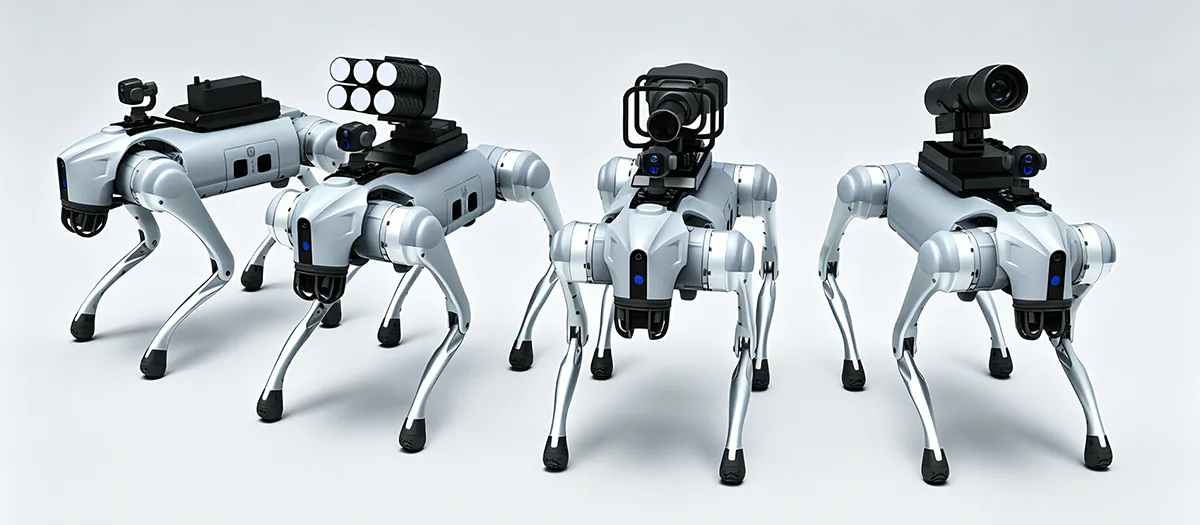
Table of Contents
Click a section to jump directly to the corresponding technical discussion.
- 1. What Defines an Industrial Quadruped Robot?
- 2. What Makes Legged Mobility Useful on Difficult Terrain?
- 3. What Autonomous Functions Improve Industrial Operation?
- 4. What Role Does Multi-Sensor Perception Play?
- 5. What Inspection Tasks Can a Quadruped Platform Support?
- 6. What Can Modular Equipment Add to the Platform?
- 7. What Conditions Should the Platform Be Designed For?
- 8. How Can Quadruped Robots Reduce Exposure to Difficult Work Areas?
- 9. How Should Equipment and Sensors Be Integrated?
- 10. What Should Buyers Evaluate Before Choosing a Platform?
- 11. What Does a Structured Deployment Process Look Like?
- 12. What Is the Future Direction of Industrial Quadruped Robotics?
- 13. Frequently Asked Questions
What Defines an Industrial Quadruped Robot?
An industrial quadruped robot is a mobile robotic platform built around legged movement rather than wheels or tracks. Its four-legged structure enables it to negotiate changes in elevation and irregular ground while carrying sensors, communication equipment, computing hardware, and other application-specific equipment.
The defining feature is not simply the appearance of four legs. The value of a quadruped platform comes from the coordination between locomotion, perception, control, power, structure, and task equipment. The robot needs to understand its surroundings, adjust its movement, maintain balance, and carry out a defined operating routine.
This system-oriented design separates industrial quadruped platforms from simple remote-controlled machines. A professional platform may support autonomous route planning, obstacle avoidance, data collection, equipment monitoring, and repeatable patrol routines. These functions allow the robot to participate in a wider operational workflow instead of acting only as a mobile camera.
Legged Mobility Four-legged movement allows the platform to negotiate stairs, slopes, gaps, uneven floors, loose ground, and other changes in terrain.
Intelligent Navigation Perception, path planning, positioning, and obstacle avoidance can support more autonomous movement through complex environments.
Expandable Platform Modular sensors and equipment can adapt the same robotic base to different inspection, monitoring, and industrial tasks.
Why quadruped mobility changes industrial automation
Traditional wheeled robots perform best on relatively predictable surfaces. Their efficiency can decrease when stairs, trenches, loose materials, raised thresholds, or uneven terrain interrupt the route. Tracked systems can handle some challenging surfaces, but they also have limitations in tight spaces and when the environment contains frequent changes in elevation.
Legged movement approaches the problem differently. Each leg can be controlled individually, allowing the robot to place its feet according to the terrain. This provides more options for maintaining balance while moving through irregular environments.
For industrial applications, the practical benefit is access. A robot that can move through more types of terrain can potentially reach inspection points, equipment areas, tunnels, workshops, and other locations where a conventional mobile platform may need additional infrastructure.
- Four-legged movement supports changing elevations and uneven ground.
- Autonomous navigation can reduce the need for continuous manual steering.
- Sensors provide environmental information for movement and inspection tasks.
- Modular interfaces allow different equipment to be installed for different applications.
- Digital data collection can connect field operations with later analysis.
Core principle An industrial quadruped should be evaluated as a complete mobile operating system. Mobility is important, but perception, control, equipment integration, power, and data functions determine how useful that mobility becomes.
What Makes Legged Mobility Useful on Difficult Terrain?
Difficult terrain is one of the clearest application areas for quadruped robotics. Industrial sites can contain steps, ramps, trenches, narrow walkways, rubble, muddy areas, uneven floors, and changes in surface height. A platform designed only for flat floors may require additional infrastructure or may be unable to reach certain areas.
A quadruped robot can place and lift its feet individually, allowing it to adapt its body posture as terrain changes. This can support movement over slopes, steps, gaps, and irregular surfaces while maintaining a more stable relationship between the platform and the ground.
Stairs and height changes
Stairs are a simple example of terrain that can challenge wheeled platforms. Each wheel needs to maintain suitable contact with the surface, while the robot must overcome repeated vertical changes. A legged platform can raise individual legs and adjust its posture to move between steps.
The exact capability still depends on the robot design, step geometry, control system, and environmental conditions. The important engineering point is that the legged structure provides additional movement options that wheels do not have.
Slopes and uneven surfaces
Industrial environments often include sloped concrete, gravel, loose soil, muddy ground, drainage channels, or transitional surfaces. A quadruped platform can adapt its leg positions and body attitude as the terrain changes.
Stable operation depends on the combination of mechanical design, perception, gait control, traction, and balance algorithms. The legs provide the physical movement capability, while the control system determines how that capability is used.
Narrow and cluttered spaces
Industrial tunnels, workshops, pipe corridors, and maintenance areas may contain obstacles that limit the available route. A compact quadruped platform can navigate through some of these spaces without requiring a continuous flat driving surface.
| Terrain Condition | Challenge for Conventional Mobile Platforms | Quadruped Design Advantage |
|---|---|---|
| Steps | Vertical changes can interrupt wheel contact and forward motion | Individual legs can be lifted and positioned across different heights |
| Steep Slopes | Reduced traction and limited body adjustment can affect movement | Leg position and body posture can be adjusted during movement |
| Rubble | Irregular contact surfaces can make wheel movement unstable | Individual foot placement provides more options for negotiating obstacles |
| Muddy Ground | Wheel or track traction can vary across soft surfaces | Leg placement can adapt to changing contact conditions |
| Gaps and Gullies | Wheeled systems may require bridging or detours | Legged movement can navigate around or over selected terrain features |
Balance matters as much as movement
Being able to move over difficult terrain is not enough. The platform needs to maintain balance while carrying sensors and equipment. Sudden changes in ground height can affect the robot's center of gravity and load distribution.
Control systems therefore need to coordinate gait, posture, sensor feedback, and movement speed. Anti-shake and anti-tip functions can help maintain stable operation within the defined operating envelope.
This is particularly relevant when the robot carries cameras or measurement equipment. Excessive movement can reduce the quality of collected data even when the robot itself remains upright.
What Autonomous Functions Improve Industrial Operation?
Industrial robotics becomes more useful when the platform can perform repeatable tasks without requiring constant manual steering. Autonomous functions can reduce operator workload while making movement and data collection more structured.
Modern quadruped platforms can combine environmental perception, positioning, route planning, obstacle avoidance, task execution, and data recording. The degree of autonomy depends on the robot architecture, sensors, software, communication conditions, and operating environment.
Environmental perception
Before a mobile robot can navigate autonomously, it needs information about the environment around it. Sensors can identify obstacles, changes in terrain, open routes, and other relevant features.
Perception data is then used by the navigation system to determine how the robot should move. In a changing environment, this process may need to run continuously rather than being based on a fixed map alone.
Path planning and obstacle avoidance
Path planning determines how the robot can travel between defined points. Obstacle avoidance helps it adjust when an object blocks the planned route or when environmental conditions change.
For industrial inspection, this can support repeatable routes around equipment, through facilities, or between designated inspection points. Operators can focus more on the inspection results rather than manually controlling every movement.
Task scheduling and data collection
An autonomous inspection routine can combine movement with sensing. The robot may travel to defined locations, collect images or sensor readings, record the results, and then continue to the next location.
This creates a digital workflow in which the movement of the robot and the collected information are connected. Instead of producing only a video stream, the system can build a structured record of inspection results.
Perceive
Sensors collect information about terrain, obstacles, equipment, and surrounding conditions.
Plan
The navigation system determines a suitable route according to available space and task requirements.
Act
Legs and control systems coordinate movement while adapting to changes in the environment.
Record
Inspection images, sensor measurements, and operating information can be stored for further analysis.
Autonomy should be matched to the environment
Autonomous operation does not mean that every industrial environment should be fully unattended. Some environments require defined supervision, remote intervention, or operator confirmation before specific tasks.
A more practical approach is to identify which parts of the workflow can be automated reliably and where human decision-making remains useful. Navigation, repeated data collection, and routine route execution are strong candidates for automation, while unusual findings may require additional human assessment.
What Role Does Multi-Sensor Perception Play?
Perception gives a mobile robot the information it needs to understand its environment and perform application-specific tasks. A single sensor rarely provides every type of information required for industrial operation.
Visual cameras can provide detailed images. Thermal sensors can reveal temperature differences. Distance sensors can help the robot understand the surrounding geometry. Other sensors can support localization, environmental measurement, or equipment-specific inspection.
Visual sensing
High-definition cameras can capture images and video for equipment observation, infrastructure checks, facility monitoring, and documentation. Visual data is often the starting point for inspection because operators can directly review the appearance of components and surfaces.
Thermal sensing
Thermal imaging can identify temperature variations that may not be obvious in visible-light images. This can be useful around electrical equipment, machinery, power systems, and other assets where abnormal heat patterns may indicate a condition requiring further evaluation.
Spatial perception
Distance and depth information can help the robot understand obstacles, corridors, steps, and other features of the environment. This supports navigation and can also contribute to mapping and spatial documentation.
| Sensor Category | Primary Information | Potential Industrial Role |
|---|---|---|
| Visible-Light Camera | Images and video | Visual inspection, documentation, equipment observation |
| Thermal Camera | Temperature patterns | Thermal condition checks and abnormal heat identification |
| Depth or Range Sensor | Distance and spatial relationships | Navigation, obstacle avoidance, and environmental mapping |
| Environmental Sensor | Defined environmental measurements | Site monitoring and application-specific data collection |
Why sensor fusion matters
Sensor fusion combines information from different sensing sources to create a more complete representation of the environment. A camera may recognize the appearance of an object, while a depth sensor provides its distance and position.
Thermal information can then add another layer by showing whether the object has an unusual temperature pattern. Combining these sources can make inspection and navigation more informative than relying on one sensor alone.
Payload choice depends on the task
More sensors do not necessarily mean a better system. Every additional component adds weight, power requirements, mounting constraints, data-processing demands, and maintenance considerations.
The right approach is to select only the information needed for the defined task. A visual inspection platform may not require a large collection of environmental sensors, while an industrial monitoring project may need several data types to produce useful results.
What Inspection Tasks Can a Quadruped Platform Support?
Inspection is one of the most practical industrial applications for quadruped robotics because the platform can move through locations that may be inconvenient for people or difficult for wheeled machines.
The robot can follow defined routes, stop at inspection points, collect images or sensor data, and return the information to an analysis system. This creates a repeatable inspection workflow that can be scheduled according to the operating requirements of a facility.
Factory and workshop inspection
In manufacturing environments, equipment is often distributed across large facilities. Some areas may be elevated, narrow, or separated by changes in floor level.
A quadruped platform can navigate selected sections of the facility and collect visual information from machines, pipelines, electrical cabinets, structural areas, and other defined assets.
Power and equipment monitoring
Thermal and visual sensors can be combined for equipment inspection where temperature differences are relevant. The robot can collect images at predefined locations and compare current results with historical records.
Tunnel and confined-area inspection
Tunnels, pipe corridors, and other narrow areas can present access challenges. A compact mobile robot can enter such spaces while carrying cameras, lighting, or other sensors suitable for the inspection task.
Infrastructure observation
Infrastructure assets often require repetitive inspection of similar areas. A repeatable robot route can help standardize image collection and provide a consistent operating sequence.
- Routine inspection: Follow predefined routes and collect recurring visual or sensor data.
- Equipment monitoring: Combine visual and thermal information for condition assessment.
- Structural observation: Capture images of selected surfaces, joints, pipes, and other physical assets.
- Data documentation: Build time-stamped inspection records for later comparison and analysis.
Inspection advantage The most useful automation is not simply replacing a walking inspection route. It is creating a repeatable cycle in which movement, sensing, data recording, and later analysis are connected.
Inspection data should be structured
A large collection of images is not automatically useful. The system should associate data with specific locations, equipment, routes, or inspection points so that operators can understand where each observation came from.
When a robotic inspection system is combined with appropriate software, the resulting information can support trend analysis, maintenance planning, and follow-up inspection. The exact workflow depends on the facility and the information required.
What Can Modular Equipment Add to the Platform?
Modularity allows one robotic platform to support different tasks by changing or adding equipment. This is particularly useful in industrial environments where several types of inspection and monitoring may be required.
Possible equipment includes visible-light cameras, thermal imaging systems, gas detectors, lighting units, communication devices, environmental sensors, and other task-specific modules. The exact configuration depends on the robot's load capacity, electrical system, mounting interfaces, and operating conditions.
Inspection equipment
Cameras and thermal imaging systems can transform the robot into a mobile inspection platform. Visual cameras can document physical conditions, while thermal sensors can provide additional information about heat distribution.
Environmental equipment
Gas and environmental sensors can allow the robot to collect measurements from areas that may not be convenient for manual access. This can support monitoring workflows in industrial facilities, tunnels, workshops, and other defined environments.
Lighting and communication equipment
Lighting modules can improve image quality in dark areas and support operation in locations with limited illumination. Communication equipment can allow operators to exchange information with personnel in the operating area.
Visual Module Captures images and video for visual inspection, documentation, and equipment observation.
Thermal Module Provides temperature-related information to complement conventional visual inspection.
Environmental Module Collects defined gas, air, or other environmental measurements according to the application.
Modularity should have defined interfaces
A modular system is only practical when equipment can be installed without creating unnecessary compatibility problems. Mounting points, electrical connections, data interfaces, physical dimensions, and weight limits should be clearly defined.
Standardized interfaces can simplify changes between equipment configurations. At the same time, specialized projects may require custom brackets, housings, or power arrangements when standard interfaces do not meet the application requirements.
Power and weight must be considered together
Every added module changes the complete operating configuration. A heavier sensor increases the load carried by the legs and propulsion system. Additional electronics may increase electrical consumption. A larger housing can affect the center of gravity or restrict the robot's movement.
Modular design therefore works best when the robot has been developed with sufficient attention to the mechanical and electrical relationships between the base platform and its equipment.
What Conditions Should the Platform Be Designed For?
Industrial environments vary significantly. A workshop floor presents different challenges from an outdoor construction area, while a tunnel introduces different constraints from an open industrial site.
Before selecting or developing a robotic platform, the environmental conditions should be defined clearly. These conditions influence structure, sensors, movement algorithms, sealing, battery behavior, and maintenance requirements.
Rain and moisture
Outdoor environments can expose robotic equipment to rain, splashing water, and high humidity. The appropriate protection level depends on the platform design and intended operating environment.
Moisture can also affect sensors and connectors. For repeated outdoor operation, these components should be considered during mechanical and electrical design rather than treated as secondary details.
Dust and loose materials
Industrial sites can contain dust, sand, debris, or other particulate matter. Such materials can enter moving mechanisms or affect sensor visibility.
Protection, cleaning procedures, maintenance access, and component selection should therefore reflect the actual site conditions.
Temperature
Battery performance, electronics, sensors, and mechanical materials can respond differently to temperature changes. A platform intended for broad temperature conditions should be evaluated against the actual range expected during operation.
Vibration and impact
Legged movement creates repeated mechanical motion, while rough terrain can introduce additional shocks. Sensitive sensors and electronic equipment therefore require suitable mounting and protection.
| Environmental Factor | Potential Effect | Design Consideration |
|---|---|---|
| Moisture | Can affect connectors, electronics, and sensors | Appropriate enclosure, sealing, and maintenance procedures |
| Dust | Can enter mechanical or electronic areas | Protection, cleaning access, and suitable component selection |
| Temperature | Can influence battery and electronic behavior | Defined operating range and relevant environmental evaluation |
| Vibration | Can affect sensor data and mechanical components | Suitable mounting, structural design, and vibration evaluation |
| Impact | Can stress legs, housings, mounts, and electronics | Structural protection and validation under defined conditions |
The environment determines the right configuration
There is no universal configuration that is ideal for every industrial site. The operating environment should be documented before the robot is selected.
Useful information can include indoor or outdoor operation, surface types, temperature range, presence of dust or moisture, corridor width, stair dimensions, expected obstacles, required payloads, and communication conditions.
How Can Quadruped Robots Reduce Exposure to Difficult Work Areas?
One important application of industrial robotics is reducing the need for people to enter locations that are difficult to access, uncomfortable, or unsuitable for routine manual inspection.
A mobile robot can carry cameras and sensors into defined areas while operators remain at a more convenient control position. This can support inspection and data collection without requiring personnel to physically follow every inspection route.
Reducing routine exposure
Some industrial tasks involve repeated movement through hot, dusty, wet, noisy, narrow, or otherwise difficult environments. Using a mobile platform for routine data collection can reduce the frequency with which personnel need to enter those areas.
The robot does not eliminate every requirement for human intervention. Maintenance, unusual findings, repairs, and tasks outside the robot's capabilities may still require trained personnel. The purpose is to move appropriate inspection and monitoring activities into a more controlled operating model.
Remote observation and communication
Camera and communication modules can provide operators with information from the field without requiring them to stand next to the equipment being inspected.
For maintenance teams, this can be useful during preliminary checks. A robot can collect visual information first, allowing technicians to determine what kind of follow-up work may be needed before entering the area.
Risk reduction depends on system design
A robot is not automatically safe simply because it is remote. The complete system needs appropriate navigation, obstacle avoidance, communication, emergency procedures, maintenance practices, and operating limits.
The robot should therefore be treated as an engineering tool with defined capabilities rather than as a universal replacement for human work.
- Define which tasks can be performed remotely.
- Establish safe operating boundaries for the robot.
- Provide suitable communication and emergency control functions.
- Maintain sensors and mechanical components according to operating conditions.
- Keep human intervention available for situations beyond the robot's defined capabilities.
How Should Equipment and Sensors Be Integrated?
Equipment integration determines whether the robot can perform its intended task without compromising mobility, balance, power availability, or data quality. A sensor that works well on a bench may require a different mounting structure once it is installed on a moving quadruped platform.
Mechanical mounting
Mounting points should support the equipment securely while maintaining sufficient access for installation and maintenance. The location of the equipment also matters because it can affect the center of gravity and the robot's movement.
For cameras and sensors that require a stable view, the mounting system should also consider movement and vibration. The equipment needs an appropriate field of view without interfering with the robot's legs or other components.
Electrical integration
Each added module creates an electrical requirement. Cameras, thermal systems, computing modules, lighting, communication equipment, and environmental sensors may have different voltage and current requirements.
The power architecture needs to accommodate these loads while maintaining compatibility with the robot's battery and control electronics.
Data integration
Modern robotic systems can generate large amounts of image, sensor, and navigation data. The system should define how information is collected, transmitted, stored, and processed.
For inspection applications, data should ideally remain connected to location and time information so that later analysis can identify exactly where a particular observation was collected.
| Integration Area | Key Question | Potential Impact |
|---|---|---|
| Weight | Can the robot carry the complete equipment package? | Influences mobility, balance, and mechanical load |
| Position | Where should the equipment be mounted? | Can affect center of gravity, field of view, and movement |
| Power | What electrical input is required? | Changes battery and power-management requirements |
| Data | How will information be transmitted or stored? | Determines communication and processing architecture |
| Maintenance | Can the module be accessed and replaced? | Affects serviceability and operating continuity |
Integration should be planned before deployment
Early planning can prevent problems such as blocked sensors, inaccessible connectors, insufficient battery capacity, or unstable equipment mounting.
Useful technical information includes equipment dimensions, weight, power consumption, connector specifications, communication interfaces, mounting requirements, operating temperature, and expected environmental exposure.
Once these parameters are known, the robotic platform can be evaluated as a complete system rather than as a base robot with equipment added afterward.
What Should Buyers Evaluate Before Choosing a Platform?
Choosing a quadruped robot should begin with the application rather than with appearance or a single performance number. A technically advanced platform may still be unsuitable if it cannot navigate the required terrain, carry the necessary equipment, operate under the expected conditions, or provide the required data.
Start with the environment
Document the surfaces, slopes, stairs, corridors, obstacles, temperature, moisture, dust, and other environmental characteristics. These factors determine what type of mobility and protection the platform requires.
Define the operating task
Identify whether the robot will perform inspection, monitoring, data collection, transportation, equipment observation, or another defined function. The task determines the equipment that needs to be installed.
Evaluate mobility
Look at more than the ability to walk. Consider stair climbing, slope handling, obstacle negotiation, stability, movement speed, turning ability, and performance on the actual surface conditions expected at the site.
Check payload capacity and integration
The complete equipment package should be evaluated, including cameras, sensors, communication devices, mounting structures, batteries, and other accessories.
Review autonomous functions
Determine whether the system can support route planning, obstacle avoidance, positioning, automated data collection, task scheduling, and remote monitoring at the level required by the project.
- Terrain: What surfaces, stairs, slopes, and obstacles must the robot negotiate?
- Task: What physical action or information must the robot provide?
- Payload: What equipment must be carried and how much does it weigh?
- Power: What is the combined electrical demand of the platform and installed equipment?
- Autonomy: Which parts of the operating workflow need automated execution?
- Environment: What temperature, dust, moisture, vibration, or impact conditions are expected?
- Maintenance: How will sensors, batteries, legs, and other components be inspected and serviced?
Selection principle The best platform is not necessarily the one with the longest specification sheet. It is the one whose mobility, sensing, power, equipment integration, autonomy, and maintenance characteristics match the actual operating environment.
What Does a Structured Deployment Process Look Like?
A structured deployment process helps turn a general robotics concept into an operating system with clear technical requirements. This is particularly important for industrial applications because the robot must work with the existing environment, equipment, procedures, and data systems.
- Define the operating scenario: Record the site layout, terrain, environmental conditions, operating routes, and target tasks.
- Identify required equipment: Determine which cameras, thermal sensors, environmental devices, lighting units, or communication modules are needed.
- Establish system parameters: Confirm weight, dimensions, power requirements, data interfaces, mounting positions, and maintenance access.
- Build the operating route: Define the areas, checkpoints, navigation paths, and inspection sequence required by the application.
- Validate mobility: Evaluate movement on the actual terrain, including stairs, slopes, obstacles, and transitional surfaces.
- Validate equipment: Check image quality, sensor readings, communication, and equipment stability during movement.
- Establish operating procedures: Define charging, maintenance, data review, intervention, and emergency procedures.
Site testing is important
Laboratory tests cannot reproduce every characteristic of a real facility. The robot should be evaluated under representative operating conditions whenever practical.
Site testing can reveal details that are difficult to identify during general development. A corridor may be narrower than expected. A stair may have an unusual height. A particular surface may provide less traction. Lighting conditions may reduce camera performance.
These findings can then be used to adjust route planning, equipment placement, sensor configuration, or operating procedures.
Data workflows should be designed with the robot
Inspection automation produces value only when the collected information can be used. A useful system should define how images and sensor readings are stored, how they are associated with locations, how abnormalities are identified, and how operators review the results.
For recurring inspection, historical records can also provide a basis for comparison. The robot can collect data using similar routes and viewpoints, making changes easier to identify over time.
Maintenance must be part of deployment
A mobile robot contains mechanical and electronic components that experience repeated movement. Legs, joints, motors, sensors, connectors, batteries, and protective housings all require appropriate maintenance.
Routine inspection should therefore be included in the operating plan from the beginning. Easy access to key components and clear replacement procedures can make long-term operation more practical.
What Is the Future Direction of Industrial Quadruped Robotics?
The development of industrial quadruped robotics is moving toward greater autonomy, better environmental awareness, stronger equipment integration, and more application-specific software. The central direction is not simply making robots walk better, but enabling them to perform complete operating workflows with less manual intervention.
Smarter embodied operation
Robots are increasingly expected to combine perception and movement instead of treating them as separate functions. A platform can use environmental information to decide where to move, how to avoid obstacles, and where to perform a task.
This creates a closer relationship between the physical robot and the software controlling it. The result can be more adaptive movement in environments that cannot be represented completely by a fixed route.
More intelligent inspection
As cameras and sensors collect more information, automated analysis becomes increasingly useful. AI-based recognition can help identify predefined visual conditions, organize inspection images, and highlight areas that deserve additional review.
For example, a system can be designed to recognize selected equipment anomalies, surface changes, or other conditions defined by the application. Human operators can then focus on verification and decision-making rather than reviewing every image with equal attention.
Greater modularity
Future industrial platforms are likely to support broader equipment combinations. A single robotic base may accommodate different inspection sensors, environmental modules, communication equipment, or task-specific devices.
This requires more standardized mechanical and electrical interfaces while still allowing customization where specialized projects require it.
Integration with industrial information systems
The next stage of industrial robotics is likely to connect physical operation with digital management systems. Robot-generated information can be combined with equipment records, maintenance schedules, maps, inspection history, and other digital data.
This allows the robot to become part of a larger industrial workflow rather than functioning as an isolated machine.
Higher Autonomy More tasks can be performed through autonomous navigation, route planning, obstacle avoidance, and scheduled operation.
Better Perception Multiple sensors and intelligent analysis can provide richer information about equipment and surroundings.
Deeper Integration Robotic platforms can connect mobility, sensors, power, data, and industrial software into a more complete operating workflow.
From mobile machine to intelligent operating platform
The long-term value of quadruped robotics lies in the combination of physical mobility and digital intelligence. A robot that can walk across difficult terrain provides the physical access. Sensors provide information. Autonomous control provides repeatability. AI-based analysis can help interpret collected data. Industrial software connects those results with wider workflows.
Each of these capabilities is useful independently, but their combination creates a much more capable platform. The more closely they are integrated, the more applications can be supported without redesigning the entire system for every new task.
Future-facing principle The direction of industrial quadruped robotics is toward task-oriented systems that combine mobility, perception, autonomous operation, modular equipment, and data intelligence within one coordinated platform.
Frequently Asked Questions
What is an industrial quadruped robot?
It is a four-legged mobile robotic platform designed for professional tasks such as inspection, monitoring, data collection, and operation in environments where conventional wheeled robots may have difficulty navigating.
Why are quadruped robots suitable for uneven terrain?
Four individually controlled legs provide more options for foot placement and body posture. This can help the platform negotiate stairs, slopes, gaps, loose surfaces, and other changes in terrain within its defined operating capability.
Can a quadruped robot operate autonomously?
Yes. Depending on the system architecture, autonomous functions can include environmental perception, positioning, route planning, obstacle avoidance, task execution, and data collection. The appropriate level of autonomy depends on the application and environment.
What sensors can be installed on a quadruped platform?
Possible equipment includes visible-light cameras, thermal imaging systems, depth or range sensors, environmental monitoring devices, lighting systems, communication modules, and other task-specific equipment. The exact configuration depends on the platform and application.
Can a quadruped robot be used for industrial inspection?
Yes. It can support routine inspection of industrial facilities, equipment, infrastructure, tunnels, workshops, and other areas by following defined routes and collecting visual, thermal, or other sensor data.
Can thermal imaging be integrated with the robot?
Yes. Thermal imaging can be used alongside conventional cameras when temperature differences are relevant to the inspection task. The sensor, mounting position, power requirement, and data interface should be evaluated as part of the complete system.
Can additional equipment be added to the robot?
Many professional platforms can support modular equipment, provided the added components remain within the defined mechanical, electrical, weight, and interface limits. Custom brackets or other integration components may be required for specialized configurations.
What should be considered before selecting a platform?
Important factors include terrain, stair and slope requirements, operating environment, payload weight, sensor requirements, power demand, autonomous functions, data workflow, maintenance access, and communication conditions.
Can the same platform support different applications?
Yes. A modular design can allow different sensors and equipment to be installed for inspection, monitoring, environmental measurement, or other defined industrial tasks. The available configuration depends on the robot architecture and equipment requirements.
How can inspection data be used after a robotic patrol?
Collected images and sensor readings can be associated with locations and inspection points, then reviewed for predefined conditions. Historical records can also support comparison between inspection cycles and help organize follow-up work.
Does autonomous operation remove the need for operators?
Not necessarily. Automation can reduce continuous manual control, but operators may still be needed for supervision, exception handling, maintenance, unusual findings, and tasks outside the robot's defined operating capability.
What environments can industrial quadruped robots be used in?
Potential applications include factories, workshops, tunnels, industrial facilities, infrastructure sites, uneven outdoor areas, and other locations where mobile inspection or data collection is required. Actual suitability depends on environmental conditions and platform specifications.
Discuss a Quadruped Robotics Project
Share the terrain conditions, inspection task, equipment requirements, payload weight, operating environment, or autonomous functions needed for your application.
contact us to discuss your project requirements